Novera Pest SpecialistsNovera Pest Specialists

Mosquito and Exterior Vector Reduction Cincinnati

Mosquito and exterior vector reduction in Cincinnati protects private properties against pathogen-bearing pests such as Culex mosquitoes transmitting West Nile virus and invasive ticks carrying Lyme disease . In…
Get My Estimate →(513) 812-8087
Mosquito and Exterior Vector Reduction in Cincinnati, oh
Quick answer
  • What is included: Site mapping, larvicide water treatment, foliage adulticide fogging, perimeter barrier application, and mechanical breeding site elimination.
  • Response timing: Service window confirmed within 24 to 48 hours for standard residential calls; emergency vector suppression prioritized for active outbreaks.
  • Pricing baseline: Residential treatments range from $300 to $650 per application depending on acreage and foliage density; exact confirmed on-site.
  • Target vectors: Aedes albopictus (Asian tiger mosquito), Culex pipiens (northern house mosquito), and Ixodes scapularis (blacklegged deer ticks).
  • Booking protocol: Direct scheduling available by dispatch line at (513) 812-8087; photo reviews accepted for property layout evaluations.

Mosquito and exterior vector reduction in Cincinnati protects private properties against pathogen-bearing pests such as Culex mosquitoes transmitting West Nile virus and invasive ticks carrying Lyme disease. In historic, dense river-valley pockets such as Over-the-Rhine and Mount Adams, exterior treatments balance narrow parcel boundaries with non-target species preservation. For larger residential acreages in Hyde Park, Mount Lookout, and Indian Hill, mature hardwood canopies create microclimates that retain midday humidity, promoting elevated mosquito reproductive rates. River proximity, combined with the city's average 44 inches of annual precipitation, leads to rapid water retention in stormwater collection basins, dense undergrowth, and architectural drainage channels across Clifton and Northside.

Decision-fit considerations center on property geography and vegetation volume. A barrier application targeting lower leaf surfaces fits yards with established shrub beds and dense perimeter hedging, while mechanical grading and biological larvicides fit properties near natural ravines in Westwood or low-lying swales in Pleasant Ridge. The operational trade-off of botanical pyrethrin mists versus microencapsulated synthetic pyrethroids balances residual longevity against pollinator-safe windows. Novera Pest Specialists adheres to Integrated Pest Management (IPM) guidelines published by the U.S. Environmental Protection Agency, strictly avoiding high-drift broadcast spraying near flowering pollinator vegetation or open municipal storm drains regulated by the Ohio Environmental Protection Agency.

Treatment execution follows an established scientific sequence to achieve predictable vector knockdown:

  1. Step 1: Property assessment mapping identifying microhabitats, drainage grades, and localized collection reservoirs across the yard footprint.
  2. Step 2: Source suppression applying biological bacillus thuringiensis israelensis (BTI) tablets into permanent birdbaths, catch basins, and unalterable water features under Ohio Department of Agriculture pesticide safety regulations.
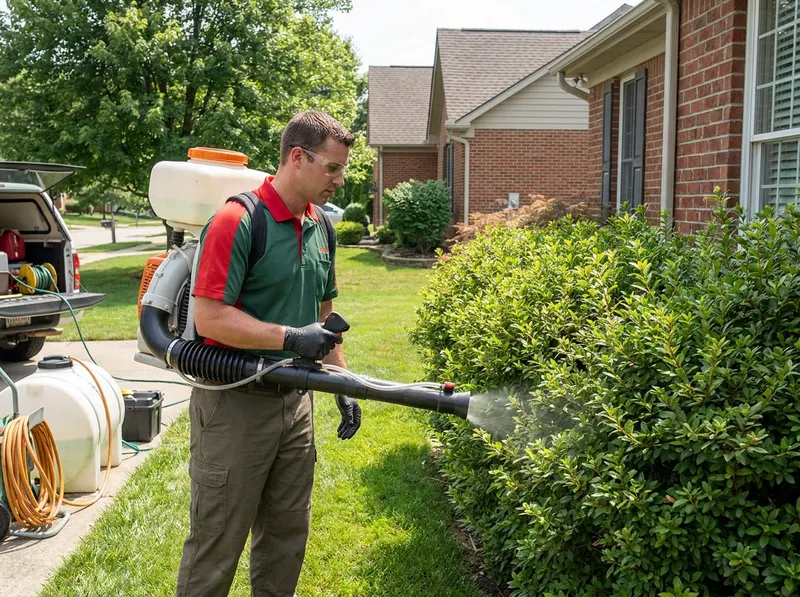
  3. Step 3: Exterior foliage treatment delivering low-volume microencapsulated adulticides to horizontal undersides of leaf canopies where adult vectors rest during peak heat.
  4. Step 4: Perimeter chemical barrier applications around human congregation zones, including patios, perimeter fencing, structural foundations, and retaining walls.
  5. Step 5: Structural post-inspection verifying absence of secondary breeding containers and ensuring adherence to child and pet re-entry safety windows.

Exterior vector control functions independently from interior structural pest remediation; interior pest sprays will not alleviate outdoor flying pest influxes, and outdoor misting cannot resolve interior rodent or bedbug activity. Homeowners with continuous wooded property borders in Oakley or Walnut Hills require barrier zones renewed on 21- to 30-day operational cycles during the active peak season running from May through October. All field remediation aligns with protocols outlined by the Entomological Society of America, vector surveillance updates from Hamilton County Public Health, and chemical application standards tracked by the National Pesticide Information Center. Safe environmental practices further reference the Pollinator Partnership guidelines and the educational resources of the Infectious Disease Vector Database. To evaluate your property perimeter, call (513) 812-8087.

How much does Mosquito and Exterior Vector Reduction cost in Cincinnati?

Urban Lot (Under 0.25 Acre - OTR, Mount Adams)$300 - $375
Standard Suburban Lot (0.25 to 0.5 Acre - Oakley, Clifton)$350 - $450
Expanded Acreage (0.5 to 1.0 Acre - Hyde Park, Mount Lookout)$450 - $650
Seasonal Maintenance Program (Per Treatment, May-Oct)$300 - $425

Every job gets a firm, written price after an on-site visit.

Common questions

How much does mosquito and exterior vector reduction cost in Cincinnati?
Residential mosquito and vector reduction in Cincinnati begins at a $300 minimum charge, with typical single-application rates ranging from $300 to $650 depending on parcel size, perimeter brush density, and standing water configurations. The exact operational cost is verified on-site by a field technician before any treatment begins.
What species are targeted during Cincinnati vector reduction applications?
Treatments in Cincinnati specifically target Aedes albopictus (the invasive Asian tiger mosquito), Culex pipiens (vector of West Nile virus), and Ixodes scapularis (blacklegged deer tick) residing in shaded brush and vegetative leaf litter.
How quickly can people and pets return to the yard after treatment in Cincinnati?
Liquid barrier applications in Cincinnati require a complete drying period of 30 to 60 minutes depending on ambient humidity, after which the treated lawn and patio areas are fully accessible for children and domestic animals.
Does rain wash away the exterior vector treatment in Cincinnati?
Modern microencapsulated formulations bond to natural foliage surfaces within one hour of application, allowing the residual barrier to withstand typical Hamilton County summer downpours without active chemical wash-off.
How does vector reduction differ from whole-yard broadcast spraying in Cincinnati?
Vector reduction utilizes targeted backpack misting specifically applied to the non-flowering undersides of ornamental leaves and larvicidal suppression in drainage fixtures, avoiding broad-spectrum chemical drenching across flowering plants or open lawns to safeguard local pollinator species.

Get started today

Tell us about your mosquito and exterior vector reduction job in Cincinnati and we'll send a clear, written quote, usually the same day.

Get your PEST CONTROL SEVICE quote, Cincinnati

We only use your ZIP to check availability, no spam.