Subterranean termites, primarily Reticulitermes flavipes , rely on direct contact with subterranean soil moisture to survive while foraging on domestic framing lumber. In historic brick and limestone foundations common…
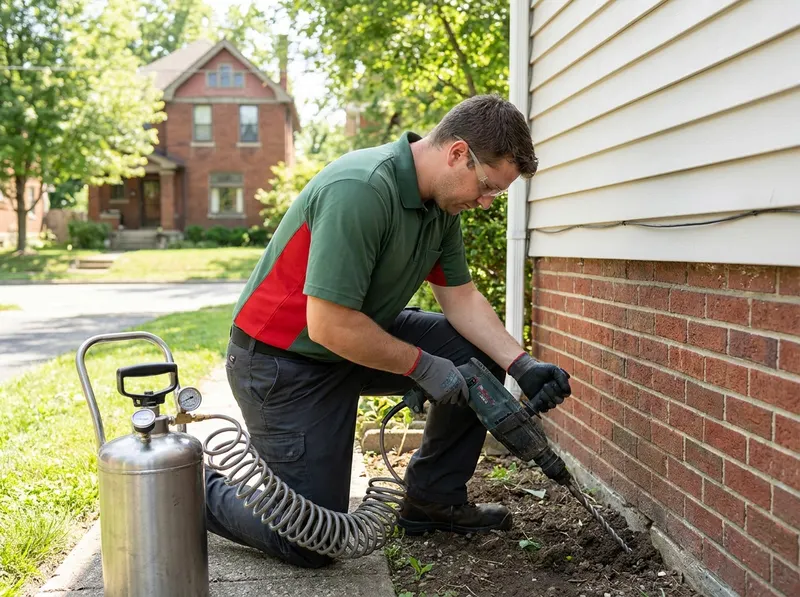
Subterranean termites, primarily Reticulitermes flavipes, rely on direct contact with subterranean soil moisture to survive while foraging on domestic framing lumber. In historic brick and limestone foundations common across Over-the-Rhine and Walnut Hills, foraging workers enter structures through mortar voids as narrow as 1/32 of an inch. Older river-valley housing inventories in Northside and Clifton often feature subterranean moisture intrusion from seasonal runoff, creating prime nesting environments beneath crawlspaces and stone footers. Unlike drywood varieties found in southern states, native Ohio colonies live underground and build sheltered mud tubes over foundation walls to access floor sills. Standard remediation relies on non-repellent termiticides that foraging insects unknowingly track back to the subterranean reproductive queen, neutralizing the colony over 60 to 90 days. Liquid perimeter barriers provide continuous containment along the foundation wall, whereas baiting systems use tamper-resistant stations installed every 10 to 15 linear feet to continuously monitor subterranean termite pressure without trenching mature landscaping.
Selecting between an exterior non-repellent barrier and an active subterranean baiting system depends on structural geometry and environmental proximity to waterways. Concrete slab foundations common in Westwood and Pleasant Ridge post-war residences frequently require interior sub-slab drilling or perimeter non-repellent fluid applications along continuous foundation perimeters. When homes sit along hillside clay shifts or near public storm infrastructure in Mount Adams and Mount Lookout, non-invasive bait matrices minimize subterranean disturbance. The protocol follows rigorous containment guidelines approved by the Ohio Department of Agriculture Pesticide Regulation, prioritizing child- and pet-conscious target placement over indiscriminate broadcast spraying. Novera Pest Specialists implements integrated protocols backed by data from the USDA Agricultural Research Service to arrest structural damage while preserving domestic hygiene.
Subterranean remediation follows a documented sequence to guarantee complete colony collapse across the structural perimeter. Step 1 begins with a comprehensive physical inspection of floor joists, rim joists, and plumbing penetrations using non-destructive acoustic sounding and moisture sensors. Step 2 isolates exterior foundation perimeters by digging a shallow 6-inch trench into the soil, keeping barrier treatments in compliance with the US Environmental Protection Agency pest safety standards. Step 3 introduces an undetectable non-repellent termiticide or tamper-resistant baiting units certified under National Pest Management Association structural guidelines. Step 4 seals all structural entry conduits using pest-proof hydraulic cement to eliminate future transit tubes. Step 5 installs tamper-resistant inspection stations checked at scheduled 90-day intervals to confirm baseline suppression, maintaining adherence to OSHA structural safety standards and municipal housing health standards established by the Cincinnati Health Department. Long-term property resilience relies on structural wood integrity standards monitored via the US Forest Service Forest Products Laboratory and moisture containment procedures documented by the US Department of Housing and Urban Development. Homeowners managing historic or modern properties can schedule remediation through a single call to (513) 812-8087, or text a photo for a quote.
Every job gets a firm, written price after an on-site visit.
Tell us about your subterranean termite remediation job in Cincinnati and we'll send a clear, written quote, usually the same day.
 Novera Pest Specialists